Sci-Fi Violence
Josh Bell, with aquatints by Briony Morrow-Cribbs
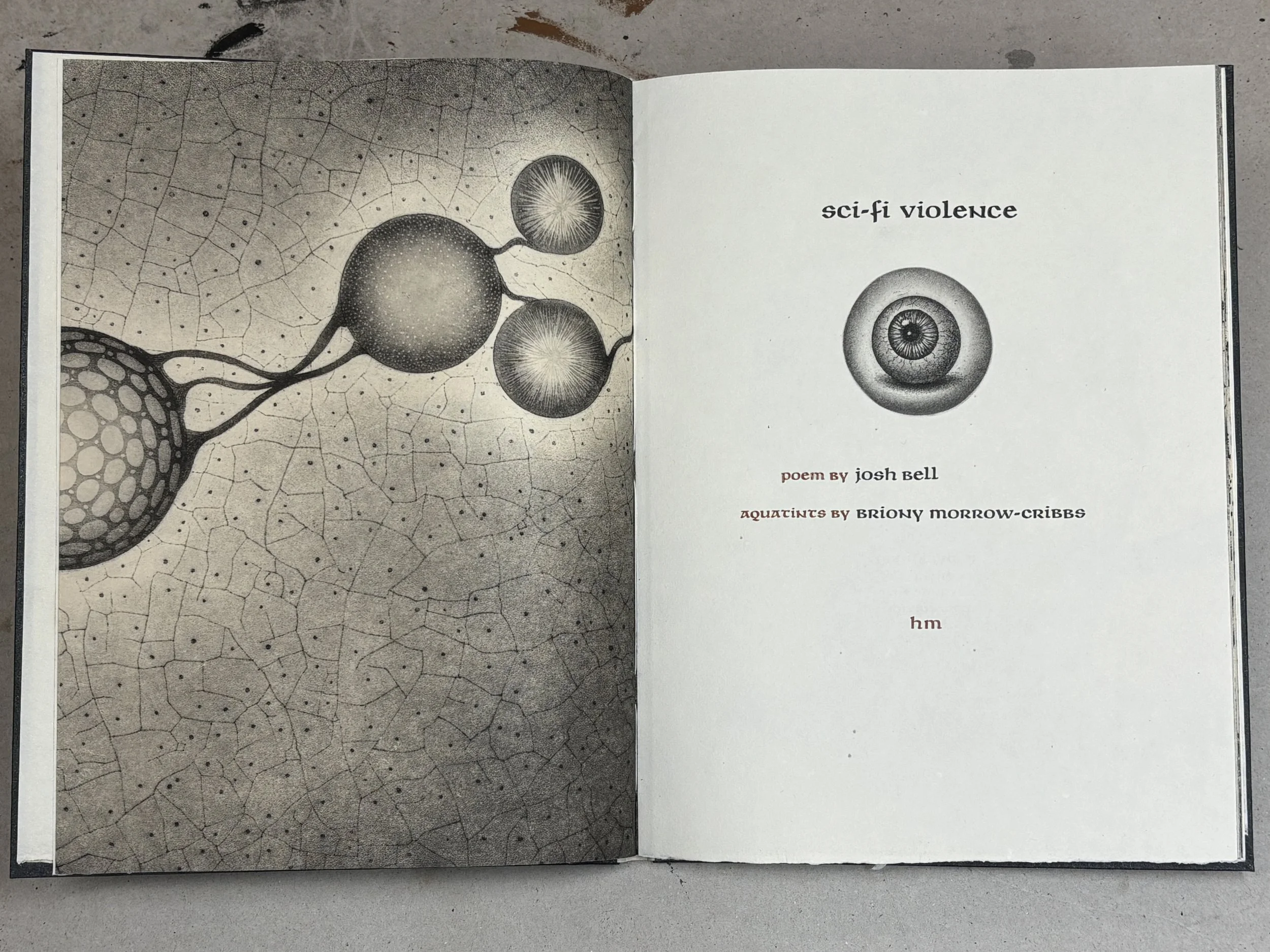
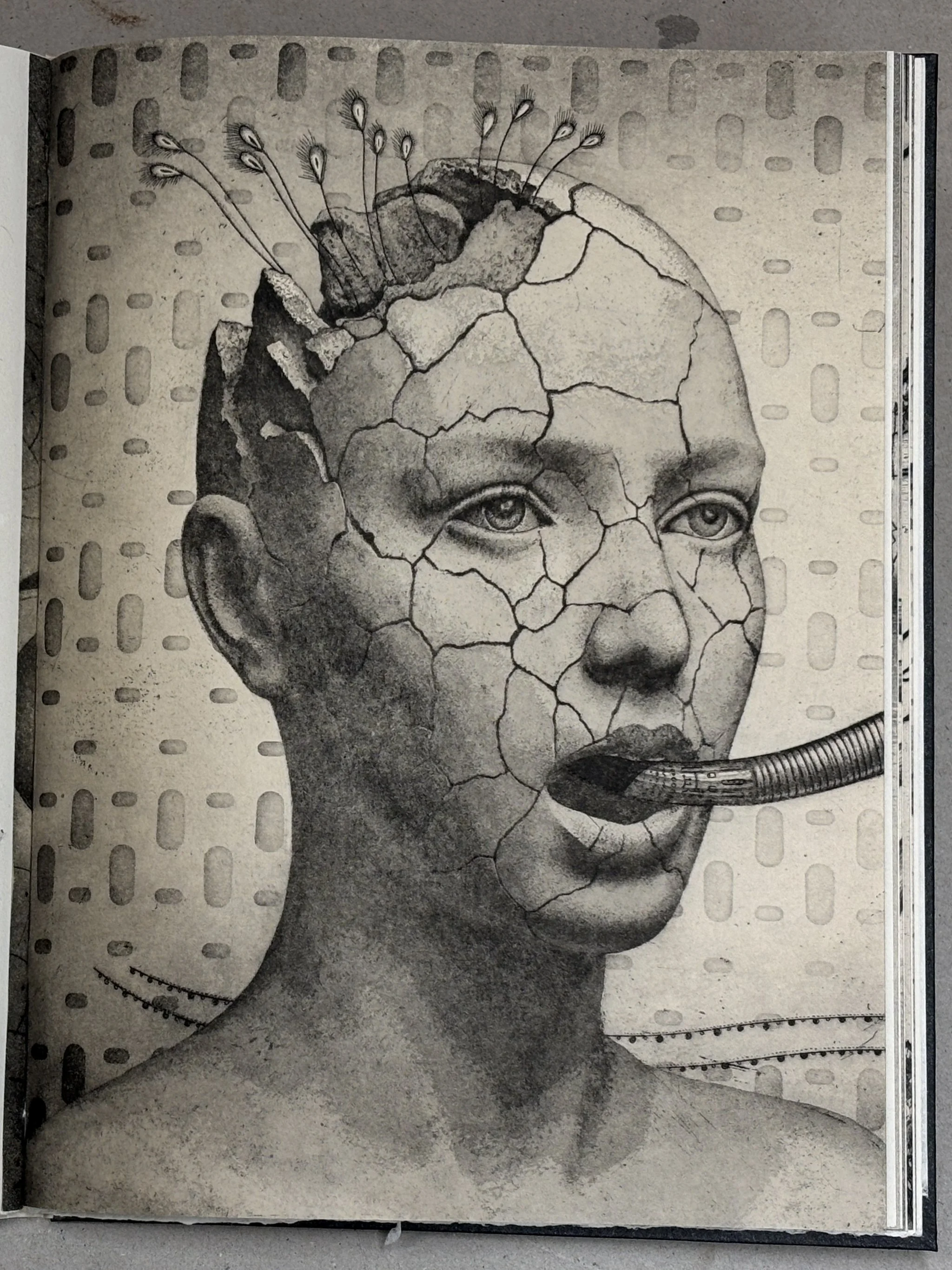
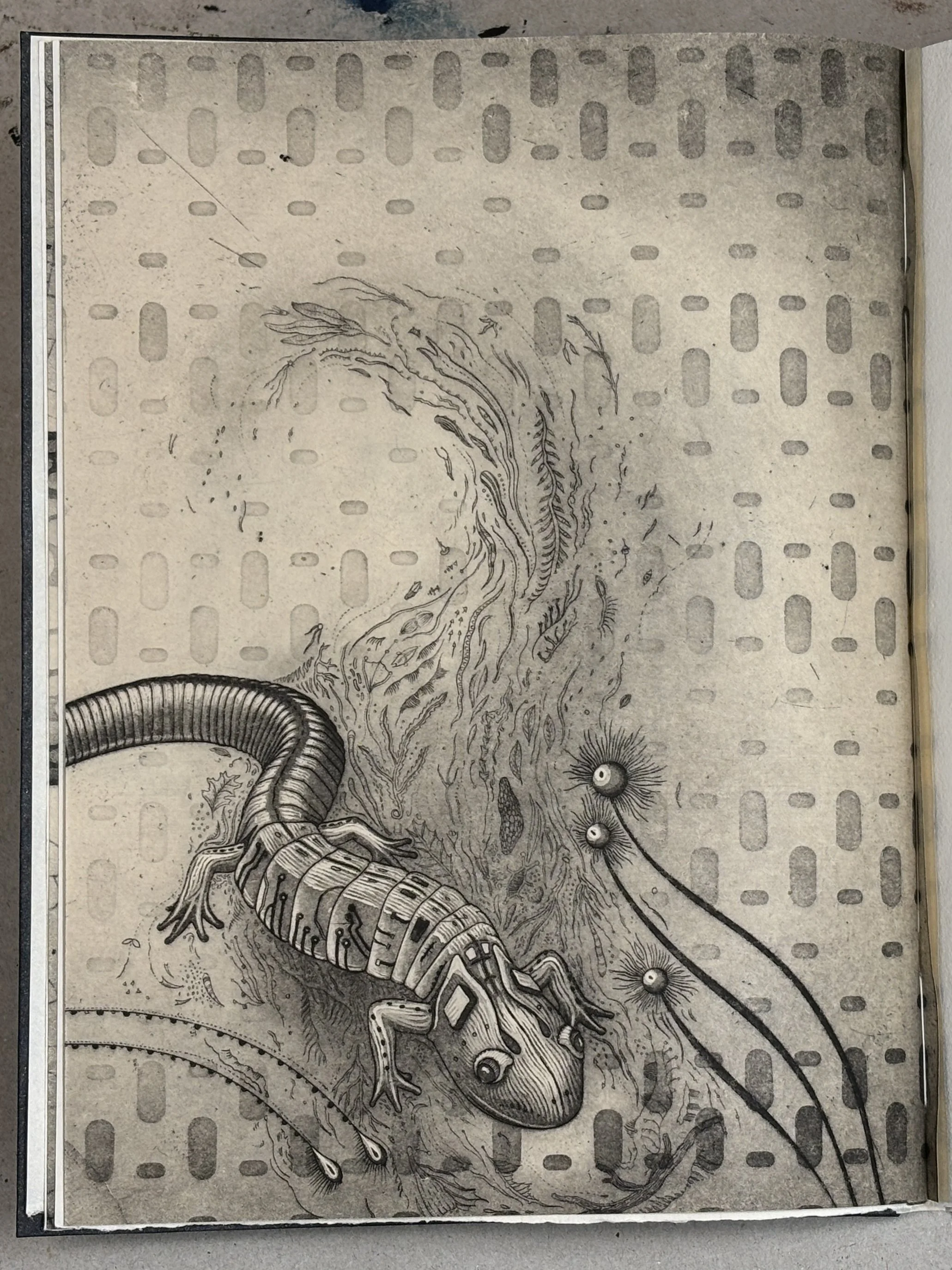
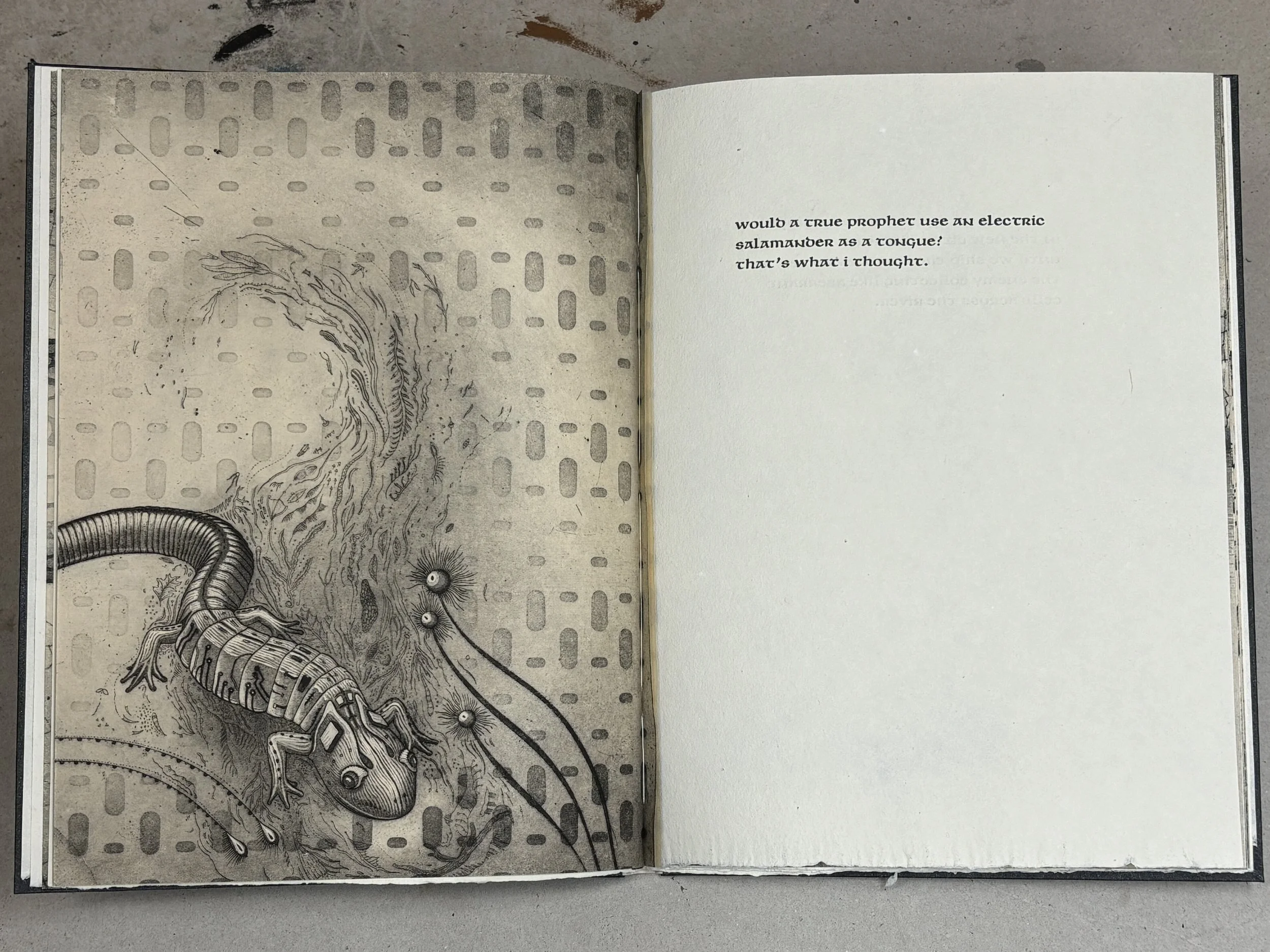
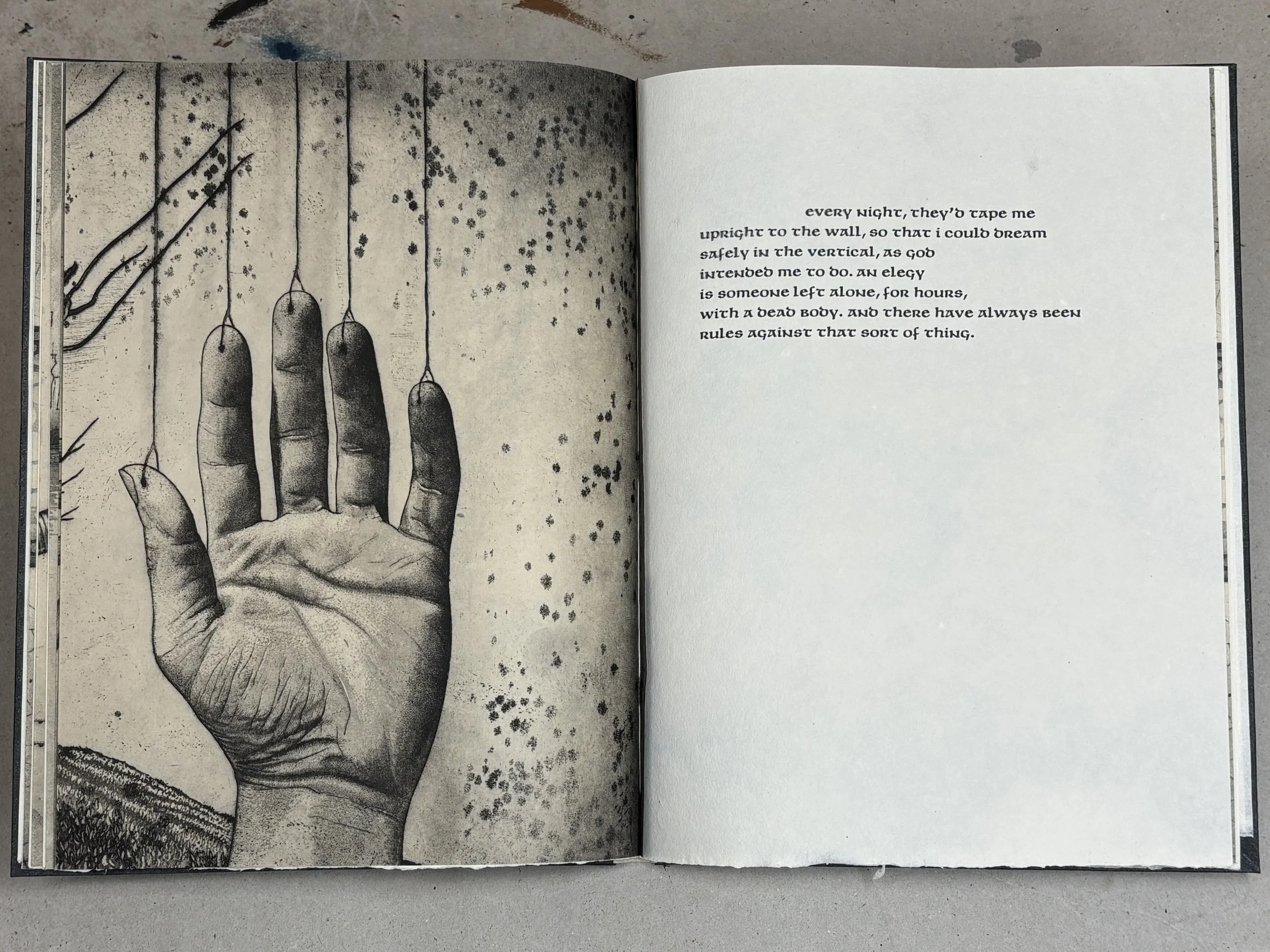
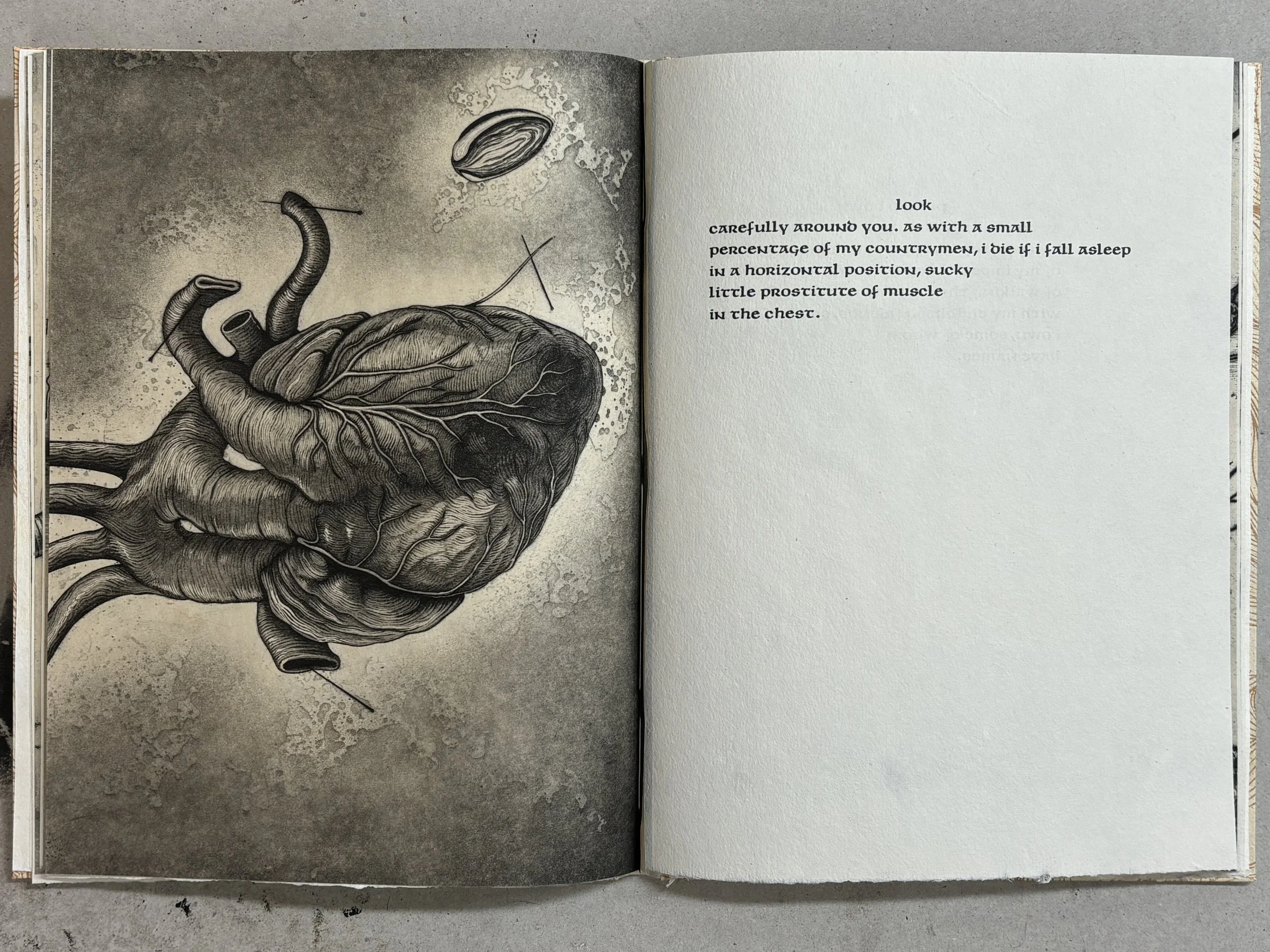
A 37-line poem by Josh Bell originally published in The New Yorker magazine (2015), set across seven pages (four leaves), each page of text facing an aquatint. The six double-page full-bleed aquatints (one is repeated – inverted – at the beginning and end) were printed by the artist on sheets of kitakata paper folded to make two pages, and sewn at the open edge; thus, to see the entire image requires the reader to hold one half in their mind’s eye while viewing the other.
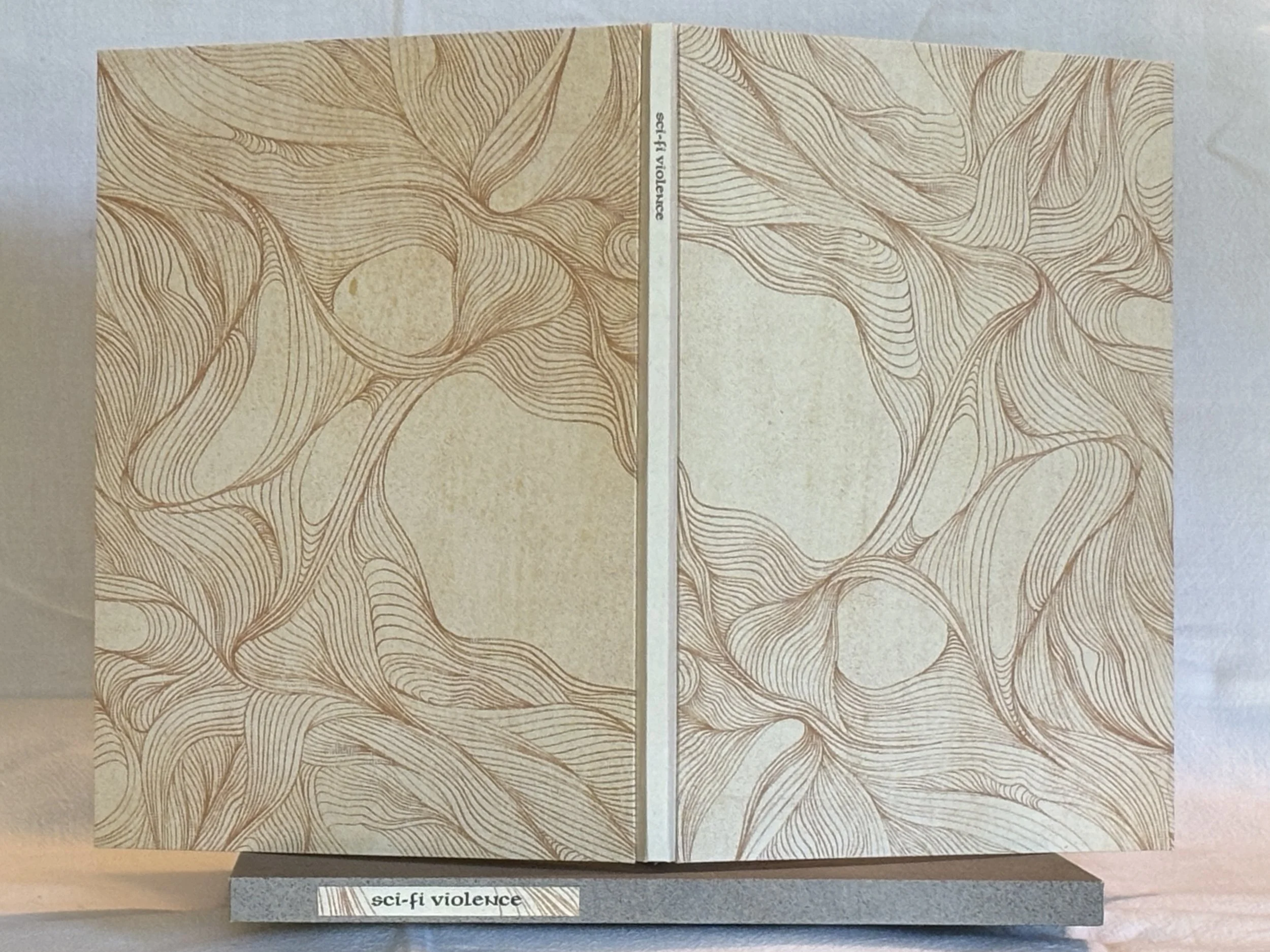
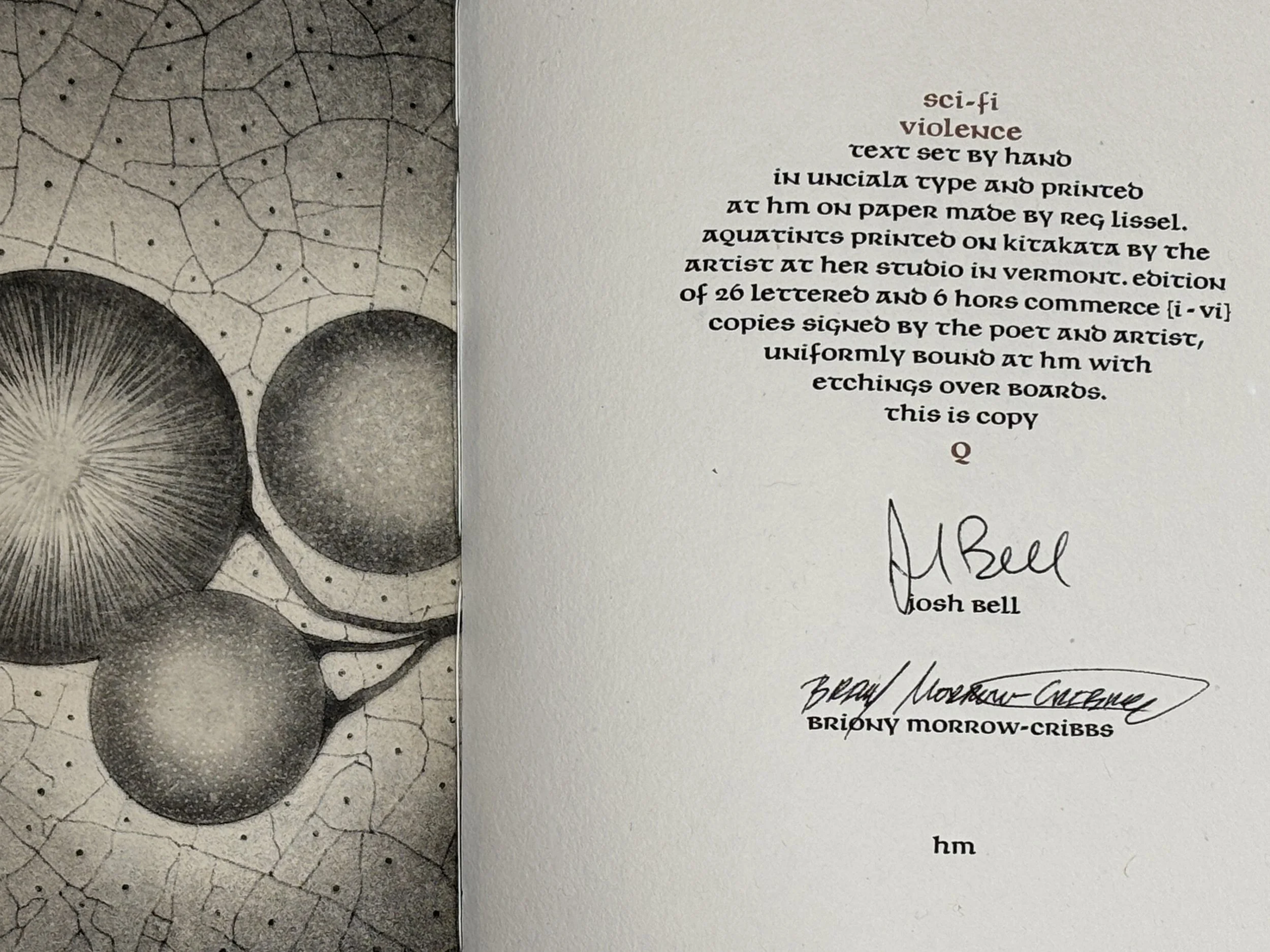
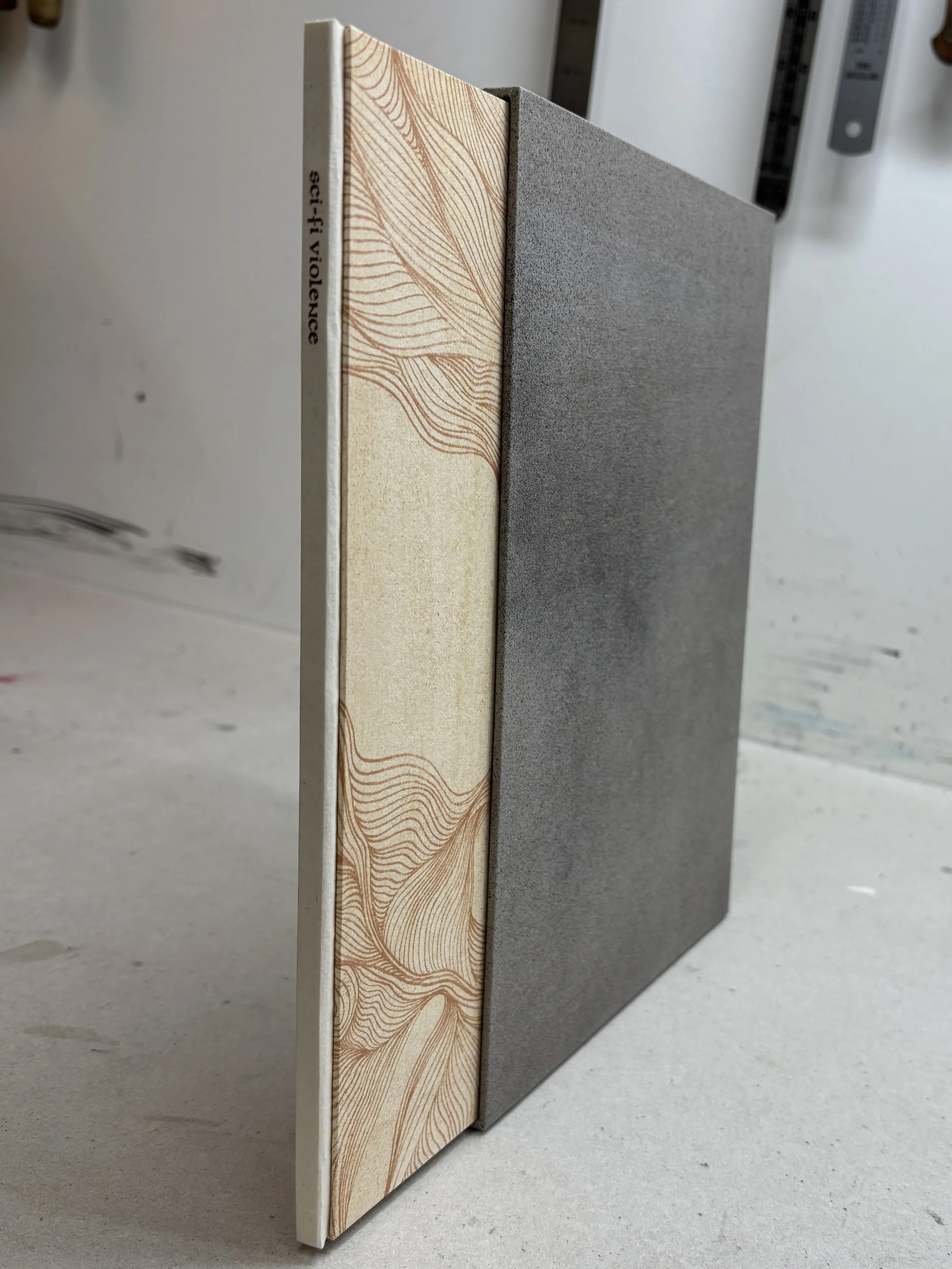
Text set by hand in Unciala type (see historical note at bottom), inked & printed by hand on dampened cream paper made (c.2012) by Reg Lissel. The title page includes a small aquatint. The edition of 26 lettered copies (and six hors commerce i – vi) was uniformly bound at HM in a case with a printed abaca-vellum spine and boards covered in an etching by Briony, printed on painted handmade paper. Issued in a painted slipcase.
Twelve printed leaves total, 7.5 × 10 inches. Cdn$1,175/US$850. Prepublication orders will receive a 20% discount. Early summer 2026.
About the Type:
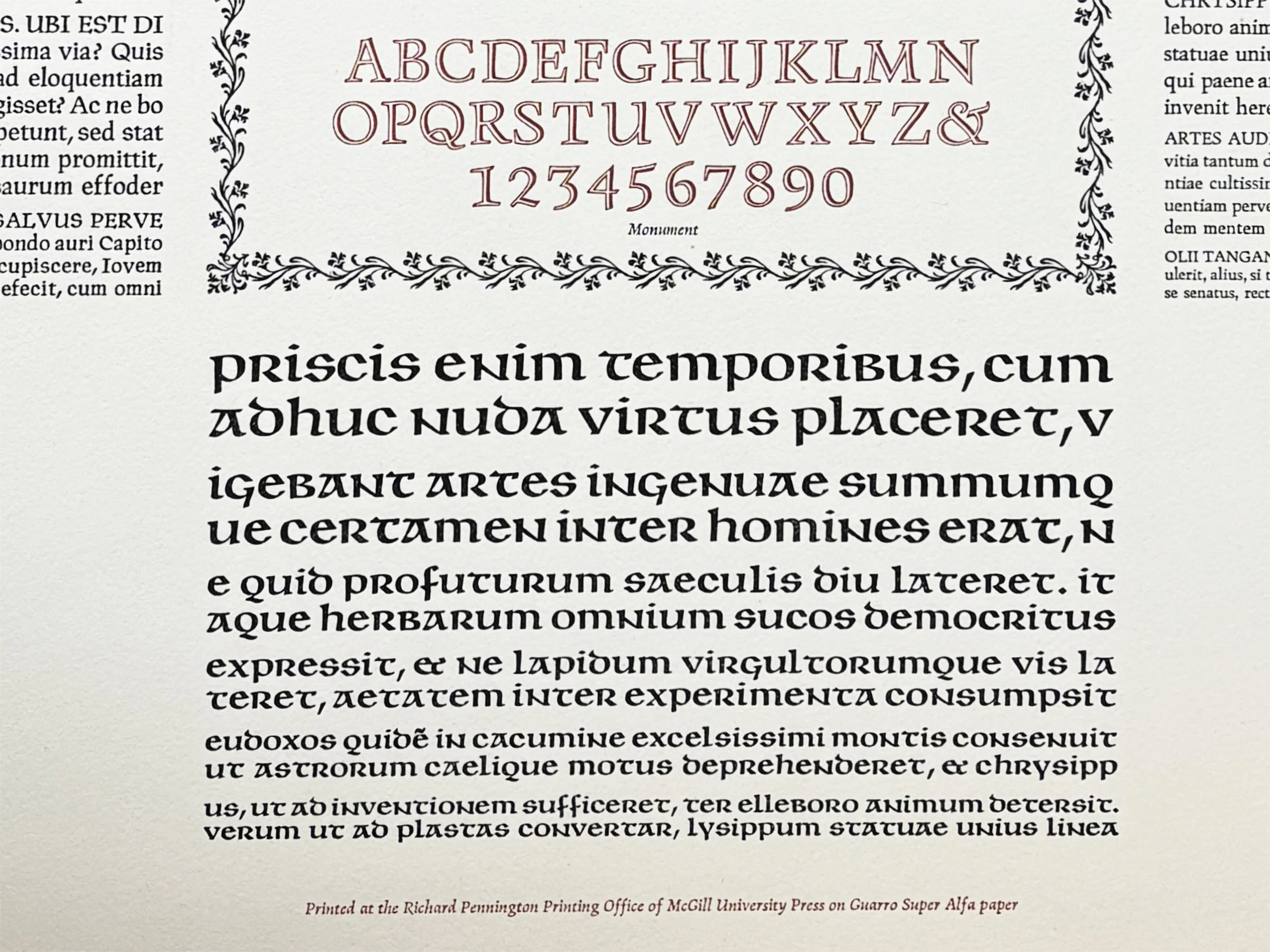
Unciala was designed in 1944 by Oldrich Menhart, and first offered for use in 1948. It is a true uncial – it does not have majuscules and miniscules.
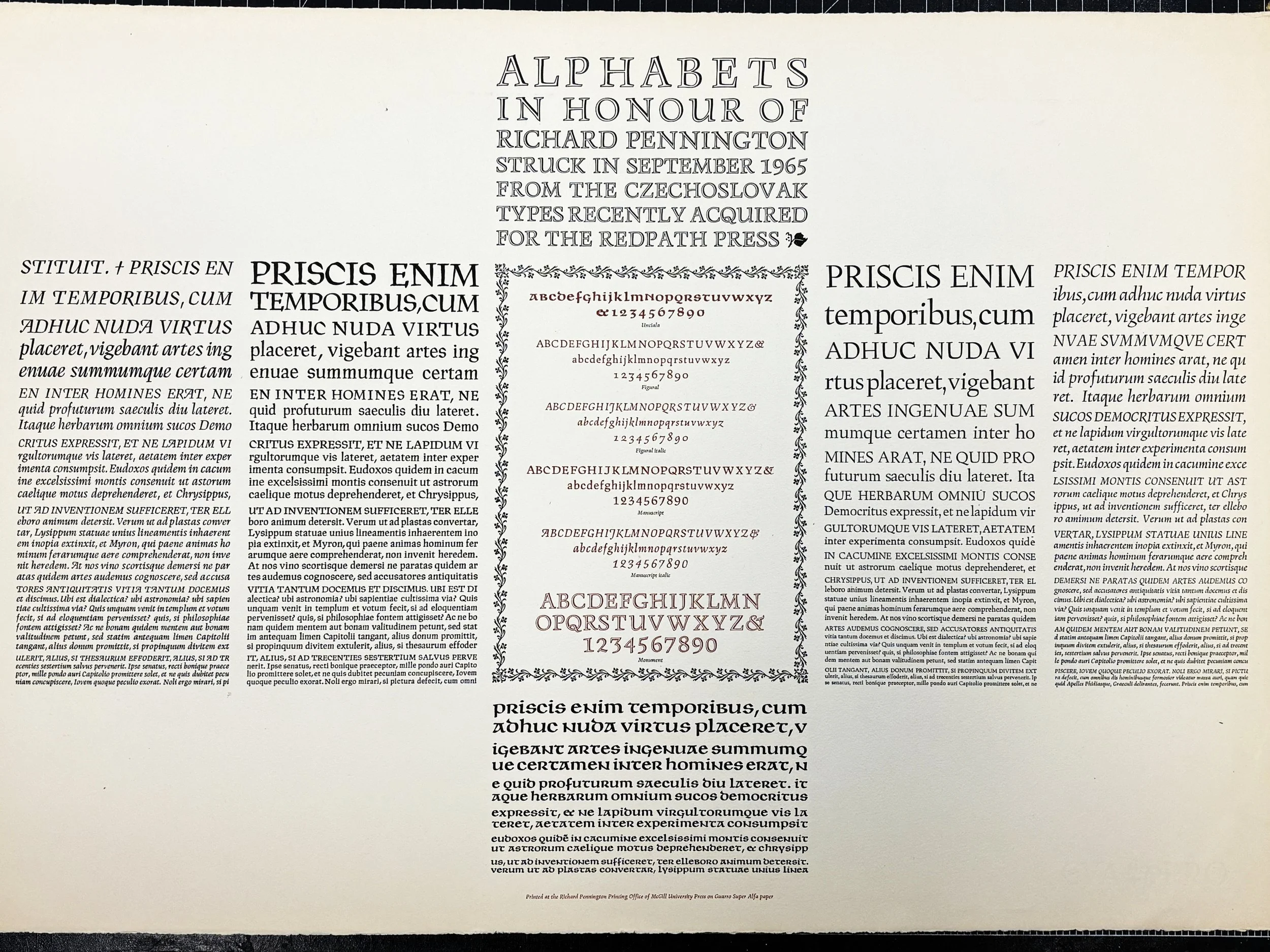
The Unciala used for Sci-Fi Violence was originally acquired (1960s) by Richard Pennington while head librarian at McGill University (why the library was buying large quantities of type I don’t know, aside from the fact that Pennington was a serious hobby printer). In 1963 Canadian typographer Robert Reid joined McGill University Press as its in-house designer. In his multi-volume autobiography, Reid recounted his role in starting the Redpath Press to print the landmark Lande Bibliography of Canadiana while at McGill:
“Shortly after I arrived at McGill, Hugh Michaelson, a former student of mine from the Vancouver Art School, called one day from the Toronto Star and said they were closing down their printing shop and had two Heidelberg cylinder presses for sale cheap. Did I know anyone who might want them. In a flash of intuition I though Fantastic, this could get the Lande book printed letterpress. I had been worrying about this because there was only one good letterpress printing shop in Canada that I would trust with the job – Morriss Printing out in Victoria. But he only had Miehle verticals, and they were too small a sheet size to do the job. This Heidelberg could solve our problem and we could print the book right here in Montreal.
“The Director and Manager of McGill University Press both thought it possible to set up a private press, as we didn’t need a lot of peripheral equipment, just a pressman to run that beautiful Heidelberg. And I knew just the person – Ib Kristensen in Vancouver, who had printed two fine editions already for me at my private press there. Richard Pennington, the University Librarian, thought it a good idea too, as he was crazy about printing. He found us the basement of Redpath Hall, which adjoins the library, and even donated fonts of all of Oldrich Menhart’s typefaces that the library purchased from Grafotechna Type Foundry in Prague [see broadside, below]. Hugh expedited the sale and shipment of the press. Ib arrived in time to supervise everything, and we were up and running very quickly.”
The Lande bibliography remains one of the most ambitious and important private press books printed in Canada. That was in part due to the fact that Bob was spending tens of thousands of 1960s dollars on materials and labor, a fact his bosses were not aware of until is was too late to stop him!
Bob left McGill around 1972, and with his departure the Redpath Press ceased operation. Much of the type – including the Unciala and Monument founts – ended up coming back west with Ib Kristensen, who eventually settled in a cabin near Yukon’s southern border. In 2005 he drove the type down to Vancouver and very generously gave it all to HM. Being foundry type and not much used, it was in beautiful condition. This is the first time the Unciala has been used in a HM book. The studio holds all the sizes shown in broadside detail (below right). Being cast in Europe, the type is Didot/Continental format, but HM doesn’t have Didot spacing material so the next size down that fit had to be used, which made handling lines of set type a bit tricky…